I knew from a very early age, that what I saw on tv had nothing to do with real life. So I wanted to make a record of real life. That included having a camera with me at all times. - Nan Goldin


An american photographer, Nan Goldin is famous for her documentary style photography of her close friends and family in the gay and transsexual community

Her photographs are honest, truthful and raw. She photographs her friends, lovers and family, embracing life as they know it.
When viewing some of her images you can instantly feel the emotion the subjects were feeling as these were not taken in a forced artistic manner, but in a more natural documentary style.

Her images take you through her journey of life, through the happy times and the not so happy times. She carries you through the decades of her teenage years in boston in the lte 60's, through to the fun free spirited late 70's in New York, onto the drug and sex fuelled 80's and 90's which led to some devastating results of dear friends who fell victim to the AIDS crisis or drug overdoses.

Through her images she shares her life with you, taking you on her journey without words. She needs no words, these images are raw and full of emotion. The composition of most of her images are just shot naturally as in the eye of the beholder, no clever angles or fancy lighting, just available light.

Her work is often presented in a slideshow format and her first in 1986 being The Ballad of sexual dependency which was 45 minutes long with a series of 800 images shown.

An interesting documentary about Nans work I found was  I'll be your mirror documentary


Gotscho kissing Gilles in Paris 1993
Joanna laughing in Paris 1992

Cookie at Vittoros casket

Nan one month after being battered 1983
Picnic on the esplanade 1973
Christmas at the otherside 


Me and Brian 
 I'm not a lover on all of Nans images but I love her method, her technique.

I have not gone into her more recent work and career, it was during these decades mentioned above that caught my attention.

 One of her most recent interviews for the Guardian she quotes


“I don’t photograph adults so much any more. I don’t have a child and, psychologically, my focus on them is a lot about me wishing that I did. But I am a godmother to friends’ children around the world – in Berlin, New York, Sweden and Italy. I don’t remember much ever feeling like a child, so maybe photographing them triggers memories. They are wild and magical, as if from another planet. And they haven’t been socially conditioned yet, so they can scream and express how they feel publicly. Sometimes I envy them. When I am in a group of people, the children and I find each other’s eyes, and end up laughing at the same, unspoken thing.

I’ve been taking pictures of children since the early 1980s, and it’s become increasingly important to me. I see a continuum in the children of my friends, some of whom have died. It’s about hoping that my friends will bring up a new species of people.”….I certainly think that my work comes from a humanistic vision of the world, rather than some kind of manipulative, theoretical version of art. It’s about the people and places I love, and that haunt me.”


The Guardian has an interview with Nan Goldin by Sarah Phillips


Researching the many photographers who have photographed their families over the years ( Sally Mann, Alfred Stiglitz etc) I have decided to opt for the documentary style.

I think capturing images in a photo-journalism way will create more raw emotion and a more candid outcome.
This type of photography is normally used when documenting historical events but I feel it will work well for my assignment.

Artistic photography is simulated, producing ( using props, manipulating the composition of the image) an image that you want the viewers to see.


Its now day 2 into my family snapping and have so far gathered about 500 shots haha, although about 50% of these are complete garbage.
I'm really struggling to keep my shutter speed nice and fast, to enable me to capture my little toddler on her hairy missions. Once a get the right exposure (lounge on an evening) its great for still shots but as soon as she starts to move I get a big blob of human mass floating around the image :(
I've adjusted my flash compensation and exposure and changed my AF mode. Ive also changed my lens from the 50mm prime to my kit lens 18mm-55mm vr lens. I've done this as I found the DOF was too shallow and I also struggled to focus on a moving object (Evie) as its manual focus. Argh!!!

I WILL get there eventually as I'm persistent and very stubborn.

Wish me luck guys and if anyone has any feedback please don't hesitate to comment x

Having researched family documentary style photography and photographers renowned for capturing their families, I feel inspired and ready to start taking photos of my family. With inspiration from others like BILLINGHAM i will try my best to capture the moment and essence of my family members character and their relationship to me.

I intend to just keep my camera round my neck and have my 18-35mm kit lens attached. Should I shoot in shutter priority? I was thinking this may be best under the circumstances of documentary style photographing? Any feedback would be greatly appreciated but in the mean time I will just experiment until I've got it right 

I spend most of my weekends with my family so it shouldn't be too hard to collect and fill my boots...I am at my grandfathers 80th on Sunday and will try to take a few shots there too, should be fun x
Update: after much appreciated feedback from my tutor I've decided to revert to my original plan of aperture priority, going no lower than 2.8, this should be easy as the lens I've chosen to use only stops down to 3.5 anyway.


I thought is was quite apt to post this as it merges my last two tasks together into one. Family photography and self portraits.So, lets say you have no photographs of your family or ancestors? Well why not impersonate said family members and take self portraits to create a family album of your own?Thats exactly what Rafael Goldchain did in his album named I AM MY FAMILY.In this series he impersonates and captures the image of each family member.

The self-portraits in I Am My Family are detailed reenactments of ancestral figures that can be thought of as acts of “naming” linked to mourning and remembrance. I Am My Family proposes a language of mourning through self-portraiture and through the conventions of family portrait photography. In reenacting ancestors through a relationship of genetic resemblance, and through the conventions of the portrait photograph, the self-portraits in I Am My Family suggest that we look at family photographs in order to 
recognize ourselves in the photographic trace left by the ancestral other.

Self-Portrait as
Motl Yosef Goldszajn Liberman
b. Warszawa, Poland 1902
d. Santiago de Chile, 1959

Self Portrait as Malka Ryten
b. Lublin, Poland, 1884
d. Tel-Aviv, Israel, 1974

Self Portrait as Pola Baumfeld
b. Ostrowiec, Poland
d. Poland, early 1940's

Self Portrait as Naftuli Goldszajn
b. Krasnik, Poland, early 1800's
d. Krasnik, Poland, late 1800's


The story of Lartigue is a fascinating one. For most of his life Jacques-Henri didn’t think of himself as a serious photographer. He kept his amazing photographs in family albums on the bookshelves of his Paris apartment and he’d only occasionally show them to friends. 

As a boy
all grown up
Born in 1894, the second son of wealthy parents, Jacques-Henri grew up in a family whose money paid for its fun and toys. Latrigue’s father raced cars, built gliders, and taught his son photography and processing when the boy was just six. Jacques-Henri’s enthusiasm for picture taking led his father to buy him his first camera when we was eight. It was the glass plate negative camera Jacques is holding in the photo. 
Jacques-Henri’s photographs of his family were mostly taken when he was between the ages of eight and twelve. 
His family were eccentric and very unique which has helped produce some amazing images.
Zissous bat 

First wife Bibi, Autochrome

Cousin Simone on land bobsled

Cousin Simone and her bobsled skids 

Boyhood photos

Brother Zissou and his tyre boat invention

Later, as a teenager, Lartigue sold a few pictures to sporting magazines but decided to become a painter rather than a photographer. Luckily, he continued photographing his life, including his three marriages, his many mistresses and his very famous friends.  
Over the years, Lartigue would show his photo albums to friends but it wasn’t until 1963, when he was 69, that they were seen by John Szarkowski, then curator of the photography department at the Museum of Modern Art in New York. Szarkowski recognized Lartigue’s genius and arranged an exhibition of his work at the museum. 
So today I began to do my research for my new assignment FAMILY.

Bill, our tutor introduced us to an artist by the name of Richard Billingham.

He is renowned for his fly on the wall documentary style photographing and videography of his family.

Richard Billingham (born 25 September 1970) was born in Birmingham UK, about an hour away from me. He studied at Bournville College of Art as a painter. He stumbled across what he is now famous for by taking numerous photographs of his family in action to then select just one single image to paint for his assignment. When showing his tutor the images, his tutor told him he was done, that ALL of these images were his final piece of work and needed to do no more AND THAT WAS THAT!
He went on to to take CANDID PHOTOGRAPHY of his family which finally became a book called RAYS A LAUGH (his fathers name being Ray)

I found after looking at his images, my first impressions of his parents were that they were alcoholic, selfish people with poor hygiene. Once viewing one of my favourite videos the FISH TANK I looked at tem from a totally different light. The dynamics and essence he captured through his photos and films is unique. The close up shots, almost following where you would be looking naturally if you were there are unique. 
You become for the duration of the move, a part of his family.

His family became totally oblivious to his filming and photographing after some time and I think this is what created the unique natural shots that he captured.


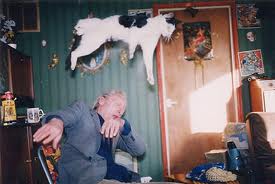
Dad Ray & cat!

Liz

RAY & LIZ


BILLINGHAM THEN WENT ON TO EXPLORE LANDSCAPE PHOTOGRAPHY.

About